
 Cart:
Cart: 

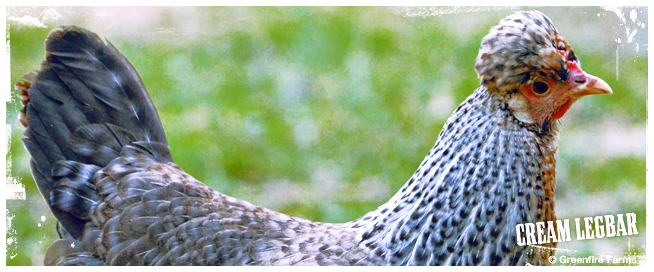
The most popular autosexing breed in the world! This blue to green-egg laying wonder bird has a rich heritage, and Greenfire Farms was the original and only importer of this marvelous chicken.
| Item | 1+ | Quantity |
|---|---|---|
| Cream Legbar Day-Old Chick Female | 29.00 | |
| Cream Legbar Day-Old Chick Male | 9.00 | |
| Exhibition Cream Legbar Day-Old Chick Female | 49.00 | |
| Exhibition Cream Legbar Day-Old Chick Male | 19.00 | |
| Exhibition Cream Legbar Eggs In stock: 5 | 14.00 | |
| Cream Legbar Eggs | 10.00 | Sold Out |
| Cream Legbar (2023 Import Line) Day-Old Chick Female | 39.00 | |
| Cream Legbar (2023 Import Line) Day-Old Chick Male | 19.00 | |
| Cream Legbar Hatching Eggs (2023 Import Line) | 12.00 | Sold Out |
Why did the chicken cross the Atlantic? Apparently to lay mountains of pastel eggs. After almost a century in Britain, with a little help from Greenfire Farms the cream legbar has made the leap to the United States, offering a new array of options for America’s backyard poultry enthusiasts. With its spiky feather crest and its penchant for laying vast quantities of sky-blue to light green eggs, the legbar is sure to get an enthusiastic welcome as the new kid on the block. But, the appeal of these obvious features pales in comparison to the revolutionary practicality cream legbars offer Americans: the ability to produce visually sexable chicks, generation after generation. For these reasons Greenfire Farms is pleased to introduce this remarkable breed to America.
Cream legbars are the most popular auto-sexing chicken breed in the world. To learn about their crucial role in the development of autosexing chicken breeds, read our section on autosexing chickens on this website.
Breed History
Cream legbars were first introduced at the London Dairy Show in 1947 and received a written standard by the Poultry Club of Great Britain in 1958. Legbars grew in popularity to fill a niche market in the British egg industry for pastel eggs produced by free-range birds. Today a variant of the cream legbar produces eggs that are marketed under the name of the Cotswold legbar –borrowing the name of Britain’s productive and beautiful pastoral region—and are viewed as the pinnacle of locally produced gourmet eggs in that country.
Given their flamboyant feathering and ability to produce pastel eggs, it’s easy to overlook the enormously practical advantage that cream legbars bring to the backyard poultry breeder; their auto-sexing function. It’s a little surreal to see cream legbar chicks hatch and helpfully provide a clear visual signal as to their gender. It’s a convenience to which we are not fully accustomed in this country. Auto-sexing chicken breeds like the cream legbar breed visually sexable chicks generation after generation.
As of March of 2024, our Exhibition Cream Legbar line has been genetically tested to be homozygous for the blue egg gene. This means that all of the offspring will also be homozygous for the blue egg gene and we guarantee this. The genetic testing was done by the IQ Bird Testing lab in Miami, Florida. We don't offer this guarantee for the Cream Legbar line.
Appearance and Behavior
Cream legbars are medium-sized fowl that are known for their active foraging and ability to survive in a free-range environment. The roosters are vigilant and protective of the hens, and the hens efficiently go about the business of gleaning every seed and insect from the fields and pastures they prefer. In 1952, seven legbar hens in England were monitored for a year. On the average they each laid 260 eggs. Cream legbar eggs are often deceptive in their appearance. They tend to be more spherical than most chicken eggs, and because of this they look shorter and therefore smaller. But, if you weigh the eggs you will find they nicely compare to other breeds. A dozen legbar eggs selected at random on our farm weighs over 25 oz. which would handily earn them a ‘large’ rating under USDA egg sizing standards.
We've noticed that this breed is a bit more on the flighty side. The hens are occasionally broody and they will peck you hand with intent when you are trying to collect eggs from under them. The hens do produce a large number of eggs and we've observed that you'll normally get about 200 eggs per year from them. So the average mentioned earlier does seem a bit higher than what we've seen. But they still lay a lot of eggs for a long time. Hens that are 3 and 4 years old are still laying steadily.
Breed Standard
Many hobbyists are interested in owning and improving cream legbars in America. A group of enthusiasts recently formed the Cream Legbar Club, and they have heavily borrowed from the British standard to create a draft cream legbar standard formatted in a manner consistent with standards adopted by the American Poultry Association. This is not an adopted standard, but it is an excellent attempt at drafting one that might eventually be adopted in America. If you are interested in breeding legbars toward a written standard, here is the Cream Legbar Club’s draft American standard for your consideration:
View the draft American Standard of Perfection
Hatching Eggs
We incubate at 99.5F and 55% humidity. Typically we see about 70% to 80% hatch from the eggs we have placed into our hatcher. The average male:female chick ratio is 50:50, however, you will notice that some hatches will be very male-heavy and some will be very female-heavy. Across multiple hatches though you should expect to see 50:50 male-to-female chicks. Chicks tend to hatch right on time, on day 21. Rarely do chicks hatch late, so if you have eggs left in the incubator that haven't pipped on day 21 you can assume that the egg will not hatch.
Notes
Greenfire Farms is the first and only legal importer of cream legbars to the United States. In the fall of 2010, two breeding groups of cream legbars were imported into the United States by Greenfire Farms. A year later we imported additional cream legbars with complementary traits. These birds were generally robust layers of blue eggs, but their feather coloration contained more gold and chestnut color than is called for in the British standard. Nevertheless, we maintain a breeding flock of these birds because some people prefer their brighter colors, and they can add genetic diversity to the limited legbar gene pool in America. We sell chicks from this flock as “cream legbars .”
In 2012, we traveled to England and viewed Cream Legbar flocks kept by award-winning breeders in that country. We’ve twice imported these exhibition lines, and the birds tend to have less chestnut and gold coloration than the birds in our Cream Legbar flock.
In 2023 we successfully imported Cream Legbar from the U.K.! We genetically tested our flock to see which birds where homozygous for the blue egg gene and only kept those to continue breeding. Since then we have been busy expanding this flock and starting in the spring of 2025, we will begin offering this line separate from our other lines. These will be sold as Cream Lebgar (2023 Import line). All of the chicks produced from this new line are guaranteed to be homozygous for the blue egg gene.
Cream legbars are the most popular auto-sexing chicken breed in the world. To learn about their crucial role in the development of autosexing chicken breeds, read our section on autosexing chickens on this website.
Breed History
Cream legbars were first introduced at the London Dairy Show in 1947 and received a written standard by the Poultry Club of Great Britain in 1958. Legbars grew in popularity to fill a niche market in the British egg industry for pastel eggs produced by free-range birds. Today a variant of the cream legbar produces eggs that are marketed under the name of the Cotswold legbar –borrowing the name of Britain’s productive and beautiful pastoral region—and are viewed as the pinnacle of locally produced gourmet eggs in that country.
Given their flamboyant feathering and ability to produce pastel eggs, it’s easy to overlook the enormously practical advantage that cream legbars bring to the backyard poultry breeder; their auto-sexing function. It’s a little surreal to see cream legbar chicks hatch and helpfully provide a clear visual signal as to their gender. It’s a convenience to which we are not fully accustomed in this country. Auto-sexing chicken breeds like the cream legbar breed visually sexable chicks generation after generation.
As of March of 2024, our Exhibition Cream Legbar line has been genetically tested to be homozygous for the blue egg gene. This means that all of the offspring will also be homozygous for the blue egg gene and we guarantee this. The genetic testing was done by the IQ Bird Testing lab in Miami, Florida. We don't offer this guarantee for the Cream Legbar line.
Appearance and Behavior
Cream legbars are medium-sized fowl that are known for their active foraging and ability to survive in a free-range environment. The roosters are vigilant and protective of the hens, and the hens efficiently go about the business of gleaning every seed and insect from the fields and pastures they prefer. In 1952, seven legbar hens in England were monitored for a year. On the average they each laid 260 eggs. Cream legbar eggs are often deceptive in their appearance. They tend to be more spherical than most chicken eggs, and because of this they look shorter and therefore smaller. But, if you weigh the eggs you will find they nicely compare to other breeds. A dozen legbar eggs selected at random on our farm weighs over 25 oz. which would handily earn them a ‘large’ rating under USDA egg sizing standards.
We've noticed that this breed is a bit more on the flighty side. The hens are occasionally broody and they will peck you hand with intent when you are trying to collect eggs from under them. The hens do produce a large number of eggs and we've observed that you'll normally get about 200 eggs per year from them. So the average mentioned earlier does seem a bit higher than what we've seen. But they still lay a lot of eggs for a long time. Hens that are 3 and 4 years old are still laying steadily.
Breed Standard
Many hobbyists are interested in owning and improving cream legbars in America. A group of enthusiasts recently formed the Cream Legbar Club, and they have heavily borrowed from the British standard to create a draft cream legbar standard formatted in a manner consistent with standards adopted by the American Poultry Association. This is not an adopted standard, but it is an excellent attempt at drafting one that might eventually be adopted in America. If you are interested in breeding legbars toward a written standard, here is the Cream Legbar Club’s draft American standard for your consideration:
View the draft American Standard of Perfection
Hatching Eggs
We incubate at 99.5F and 55% humidity. Typically we see about 70% to 80% hatch from the eggs we have placed into our hatcher. The average male:female chick ratio is 50:50, however, you will notice that some hatches will be very male-heavy and some will be very female-heavy. Across multiple hatches though you should expect to see 50:50 male-to-female chicks. Chicks tend to hatch right on time, on day 21. Rarely do chicks hatch late, so if you have eggs left in the incubator that haven't pipped on day 21 you can assume that the egg will not hatch.
Notes
Greenfire Farms is the first and only legal importer of cream legbars to the United States. In the fall of 2010, two breeding groups of cream legbars were imported into the United States by Greenfire Farms. A year later we imported additional cream legbars with complementary traits. These birds were generally robust layers of blue eggs, but their feather coloration contained more gold and chestnut color than is called for in the British standard. Nevertheless, we maintain a breeding flock of these birds because some people prefer their brighter colors, and they can add genetic diversity to the limited legbar gene pool in America. We sell chicks from this flock as “cream legbars .”
In 2012, we traveled to England and viewed Cream Legbar flocks kept by award-winning breeders in that country. We’ve twice imported these exhibition lines, and the birds tend to have less chestnut and gold coloration than the birds in our Cream Legbar flock.
In 2023 we successfully imported Cream Legbar from the U.K.! We genetically tested our flock to see which birds where homozygous for the blue egg gene and only kept those to continue breeding. Since then we have been busy expanding this flock and starting in the spring of 2025, we will begin offering this line separate from our other lines. These will be sold as Cream Lebgar (2023 Import line). All of the chicks produced from this new line are guaranteed to be homozygous for the blue egg gene.
| Egg Color | blue to green |
| Egg Size | Medium |
| Average number of eggs per year | 150 - 200 |
| Gamefowl | No |
| Country of Origin | UK |
| Cold tolerant | Yes |
| Year of import(s) | 2012 |
| Landrace | No |
| Great for beginners | Yes |
| Free-range ability | Moderately. |
| Broodiness | Very |
| Ideal Rooster-to-hen Ratio | Average, 1:10 |
| Auto-sexing | Yes |


